It sounds like the start of a joke. It turned into a company.
All three of us studied chemical technology. We spent years on reactors, heat exchangers and process curves, learning that the difference between a good product and a great one is usually a few degrees, a few percent humidity and a lot of patience.
When we first tasted black garlic, we recognised the chemistry immediately: a slow Maillard reaction, run for weeks instead of minutes. We also noticed that almost everything on Indian shelves was imported. India grows a huge share of the world's garlic, so why weren't we ageing our own?
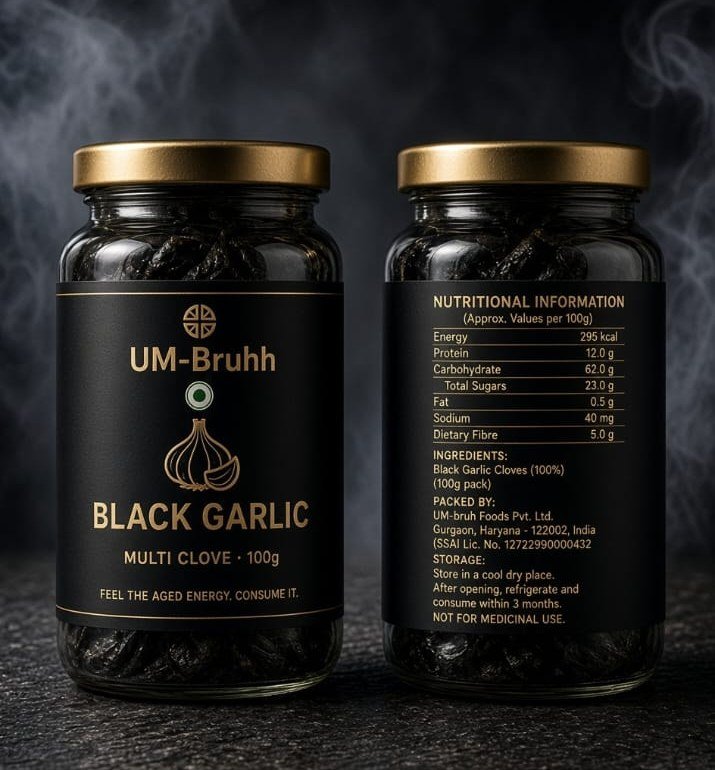
So we built our own ageing chambers, logged every batch, ruined quite a few, and kept adjusting until the cloves came out exactly how we wanted: jet black to the core, soft but not wet, sweet but still savoury.
B.Tech, Chemical Technology
“Runs the ageing chambers like a mission-control room.”
B.Tech, Chemical Technology
“Has tasted more black garlic than anyone should.”
B.Tech, Chemical Technology
“Came up with the name. Takes full responsibility.”
One jar of imported black garlic and a long argument about how it was made.
Dozens of test batches across different temperatures, humidity levels and Indian garlic varieties, each one logged, tasted and scored.
Black to the core, date-soft, with that balsamic-jaggery sweetness. Three people said “bruhh” at the same time.
FSSAI licensed, packed in Gurugram, and shipped to kitchens across India.
No shortcuts and no pressure-cooking the process. Every batch gets the weeks it needs.
Logged temperature and humidity curves, batch records and a tasting panel. It's an engineer's way of cooking.
One ingredient on the label: garlic. No sugar, no preservatives, no colour.
UM is for umami, the deep savoury taste black garlic is packed with. “Bruhh” is the sound nearly everyone makes after their first clove: a pause, raised eyebrows, then “bruhh… what is this?” We thought that deserved to be the name.
Have your own bruhh moment